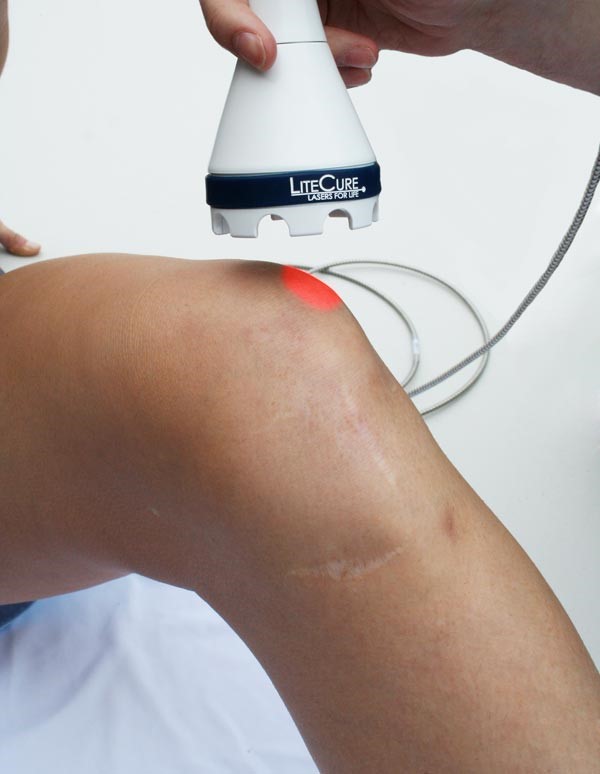
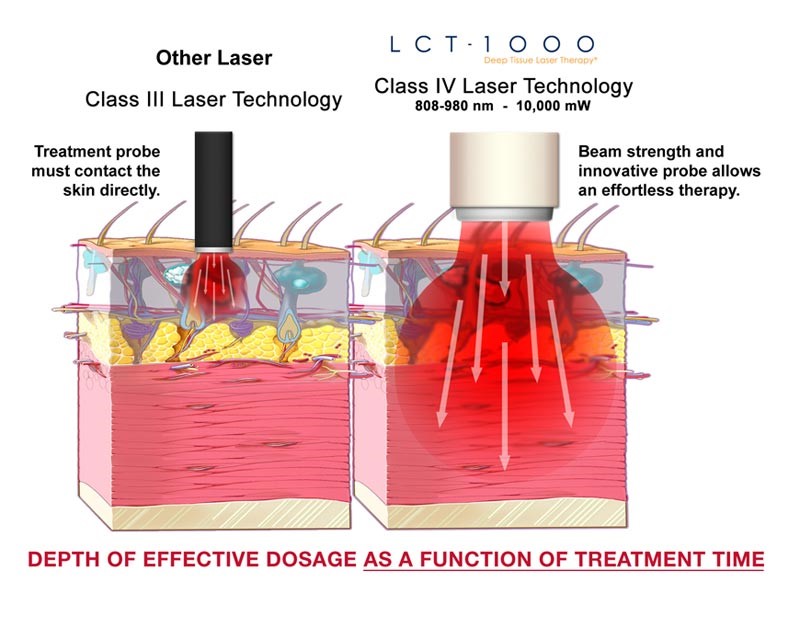
What can Class IV laser therapy do?
It reduces pain and inflammation, and accelerates healing, all in a non-invasive and non-pharmacological way. Symptoms often improve within the first few treatments. Acute conditions are treated until resolution, while chronic conditions are treated until improvement is noted, then treated with reduced frequency to maintain the effect.
- Class IV laser therapy works to decrease pain perception through its effect on nerve cells and nociceptors, by increasing stimulation thresholds, reducing neuronal impulses, and increasing the release of tissue endorphins.
- Inflammation is reduced by decreasing the release of prostaglandins and inflammatory mediators, increasing macrophage activity and leukocytic phagocytosis, and by reducing edema through dilation of the lymphatic vessels and activation of the lymph drainage system.
- Healing is accelerated by increased blood flow from vasodilation, increased angiogenesis and capillary production, increased release of pro-healing cytokines, and the stimulation of fibroblast activity and collagen production.
Good for acute and chronic conditions
- Many practices incorporate the use of Class IV laser therapy into routine protocols after surgery and dental procedures to reduce post-procedure pain and inflammation. Single treatments are administered immediately after routine procedures with moderate tissue disruption, like elective surgeries. Procedures resulting in greater tissue disruption, like orthopedic surgeries, are treated immediately post operatively and then every other day for four to six treatments.
- Patients with a wide variety of acute problems can benefit. Common among these problems are the components of pain, inflammation and tissue healing. These conditions may be treated only once or multiple times over several days or weeks, depending on the severity of the condition. Examples include wounds, fractures, abscesses, anal sacculitis, acute otitis, hematomas, sprains, strains, muscle discomfort, cystitis, urethritis, injection site soreness, pyotraumatic dermatitis, venomous bites and pododermatitis.
- Chronic conditions involving pain, inflammation and healing may also be helped, although treatment has to extend over a longer time, and will be followed by ongoing treatment to maintain effect. Osteoarthritis, elbow hygromas, lick granulomas and neuropathies are examples. Chronic conditions are treated through an initial Induction Phase of treatments until a clinical response is noted. Patients then are treated through a Transition Phase of gradually reduced frequency of treatment, to establish the frequency that will maintain effect. They then enter a Maintenance Phase of treatment every three to six weeks.
Lorem ipsum dolor sit amet, est ea audire quaeque inciderint. Ea congue nominavi honestatis usu. Vis iuvaret instructior no. Erat accusam voluptua an mei.
Ad dicta delenit nusquam vix. Vel an graecis habemus, eum primis adversarium id, et probo etiam est. Ne magna putent ullamcorper quo, ex omnes iuvaret appareat mei. Pri tale sadipscing at. Graecis voluptaria mei ad, stet voluptatum et qui. Ex duo inani liber iriure.
Cetero vocibus cu nec. Eam an autem gubergren, quo ex tritani appellantur. Graecis mnesarchum id vim, an paulo electram principes mei, ut ius falli integre senserit. Vis et probatus hendrerit mediocritatem.
Et movet ancillae vis, mentitum suscipiantur ne mel. Ubique numquam percipitur ne quo, te nam erant iusto. Ea unum rebum salutandi vis. Tempor primis cu duo, eam eu nominati voluptaria, ne sit veritus accusam. Et eos tale eius diceret, pri amet eruditi fuisset ad.